
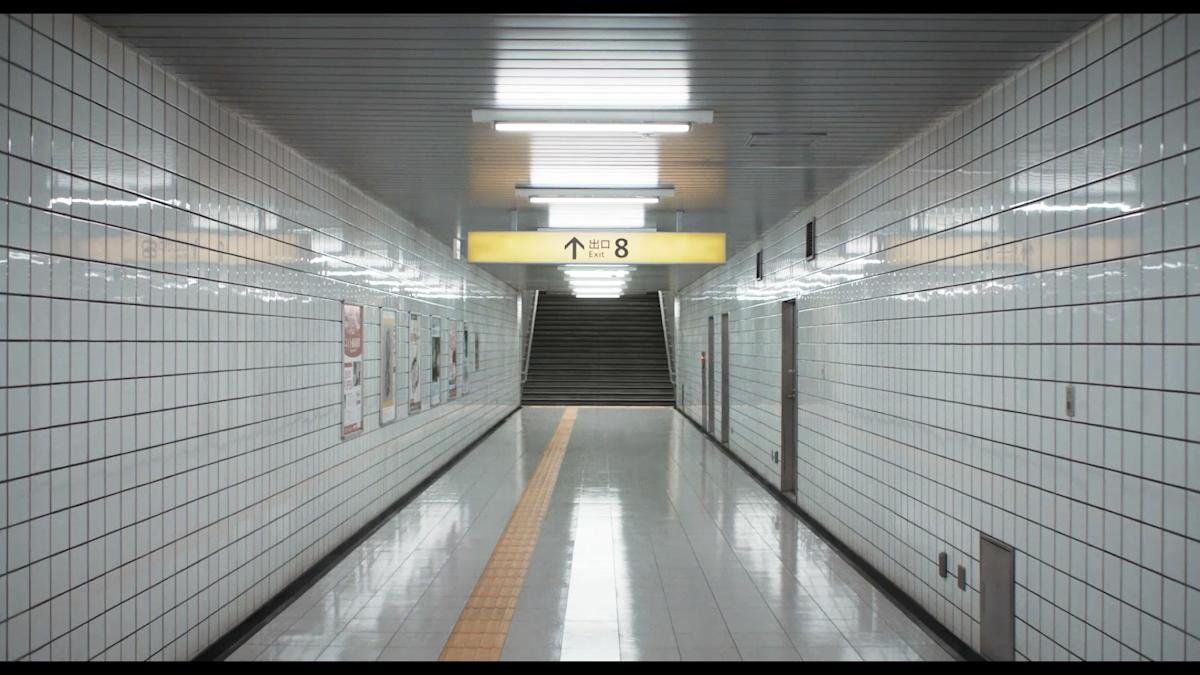
The rules of Exit 8, both the cult indie game and the recent film adaptation, are simple: You’re stuck in a subway station that loops around endlessly. If you notice any anomalies on your current loop, you turn around. If everything is the same, you keep going forward. Each successful guess takes you to a new entrance where the loop recurs, until you reach the end of the labyrinth, Exit 8 itself.
It’s a setup that perfectly suits a first-person video game, where you can fully control where your character looks and moves. And it’s also something director Genki Kawamura deftly replicates in the film through long tracking shots and sweeping camera movements. Even without a controller, or a keyboard and mouse, the viewer remains immersed, looking and listening for any minor changes. Within just a few minutes, the film makes it clear it’s not just another thoughtless video game adaptation like The Mario Galaxy Movie — it’s an attempt to translate the experience of the game to an entirely new medium.
That’s a daunting challenge for most artists, but Kawamura is no stranger to jumping between formats. He’s known for producing popular anime films from the likes of Makoto Shinkai and Mamoru Hosoda, including Your Name and Belle. He’s also made a name for himself as a best-selling author, with books including the novelization of Exit 8.
Kawamura’s perspective for the film came from a conversation with Nintendo’s legendary game designer Shigeru Miyamoto, who had mentioned that the greatest games are both fun for the players and people watching them. “So what I tried to do in the film is to really place the audience in the shoes of the player in certain shots… almost like they were watching a live stream of a video game in other scenes,” he said in an interview with Engadget (via a translator). “That’s kind of structurally the through-line of the film.”
The Exit 8 adaptation balances that sense of immersion with a more traditional narrative structure, something the game lacked entirely. As the film begins, we’re introduced to a young man standing in a crowded train. A drunken businessman shouts at a mother to quiet crying baby down. Instead of telling the belligerent salaryman to fuck off, the young man plugs in his earbuds and tries to ignore the situation, just like everyone else. He eventually steps off, while the tearful mother suffers through the verbal assault.
It’s a scene that anyone who’s lived in a crowded city can relate to — the moments where you know you should try to help a stranger, but fear, cowardice or embarrassment hold you back.

Exit 8 (NEON)
Shortly after receiving a call from his ex-girlfriend, who reveals that she’s pregnant, the young man stumbles into the Exit 8 loop. At first, it’s just a normal subway station, with large poster ads, a photo booth and random maintenance doors. But he quickly notices that the room repeats itself. Thanks to a helpful set of instructions on the wall, he learns that his only way out is to start tracking anomalies, like slight changes in text, or the way a robotic businessman walks past him. And yes, things get freaky quickly.
Kawamura points to his experience working in animation as a major influence for Exit 8. In particular, the works of Satoshi Kon and Katsuhiro Otomo influenced how he externalized what characters were thinking and feeling, as well as how he depicted the interaction of dream and real worlds.
” When we were filming, I told my DP [director of photography] that the main character of this film is the corridor,” he said. “And all of our human characters, they have no names, so therefore they’re NPCs in this corridor, which is the main character. So I wanted the corridor to almost evoke this feeling in the audience that it has a will of its own. And this yellow Exit 8 sign is almost like this divine God-like being.”
Kawamura says he personally views it as the corridor challenging humans who have a guilty conscience, but you can easily read in other meanings. More importantly, Exit 8 isn’t merely a faithful recreation of the source material — it adds enough to make a case for existing a separate medium, a challenge many video game adaptations fumble.